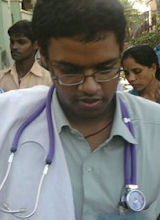


Toronto, Nov 8 (IANS) In a major breakthrough in medical sciences, an Indo-Canadian researcher and his team have successfully transformed human skin into various blood cells.
The breakthrough is likely to pave the way for revolution in the treatment of patients needing blood transfusions and those suffering from blood disorders.
Mike Bhatia and his team at Canada's McMaster University at Hamilton have successfully harnessed human skin to produce red bloods cells, two kinds of immune cells and the cells that produce platelets needed in clotting, the Indian-origin researcher said Sunday.
Bhatia, who heads McMaster University's Stem Cell and cancer Research Institute, told the Canadian Press, 'We have shown this works using human skin. We know how it works and believe we can even improve on the process''
It will also pave the way to produce transplant tissues without ever making the controversial embryonic stem cells first. The breakthrough will also cheer cancer patients whose blood systems (blood cells) are badly affected by chemotherapy.
It also throws up the exciting possibility of brain neurons being harvested in lab from a mere patch of one's own skin to repair damage to brain cased by accidents or diseases.
The new technique will one day lessen the burden on blood banks as this process can reportedly create enough blood from one's own skin for transfusions.
Though blood cells can be derived from embryonic stem cells and what are known as induced pluripotent stem (iPS) cells, this process is far more complicated and time-consuming, the Canadian Press quoted Bhatia as saying.
Moreover, blood cells derived from embryonic cells and iPS cells can be 'fetal' - not mature adult cells - with properties that make them unsuitable for transfusion, said Bhatia.
But the new skin-to-blood cell technique will carry no such dangers.
'Because we were starting out with adult fibroblasts (skin cells), we actually made adult blood, which we are predicting is going to be far more useful.''
Bhatia and his team grew blood cells from skin cells in Petri dishes in their lab, and then transplanted them into specially bred mice to see how they behaved. Tests so far have shown no ill-effects like cancerous growth - a danger with both embryonic and iPS cells.
Interestingly, the age of human skin will be no barrier in producing blood cells from it as Bhatia and his team used skin (cells) from people aged six to over 60 to produce blood vessels.
'What we found was it didn't make a difference. We were able to convert all of the human skin cells to blood independent of how aged the person was,'' Bhatia told the Canadian Press.
The research appeared in the journal Nature Sunday.
source- yahoo news


Join The Community